
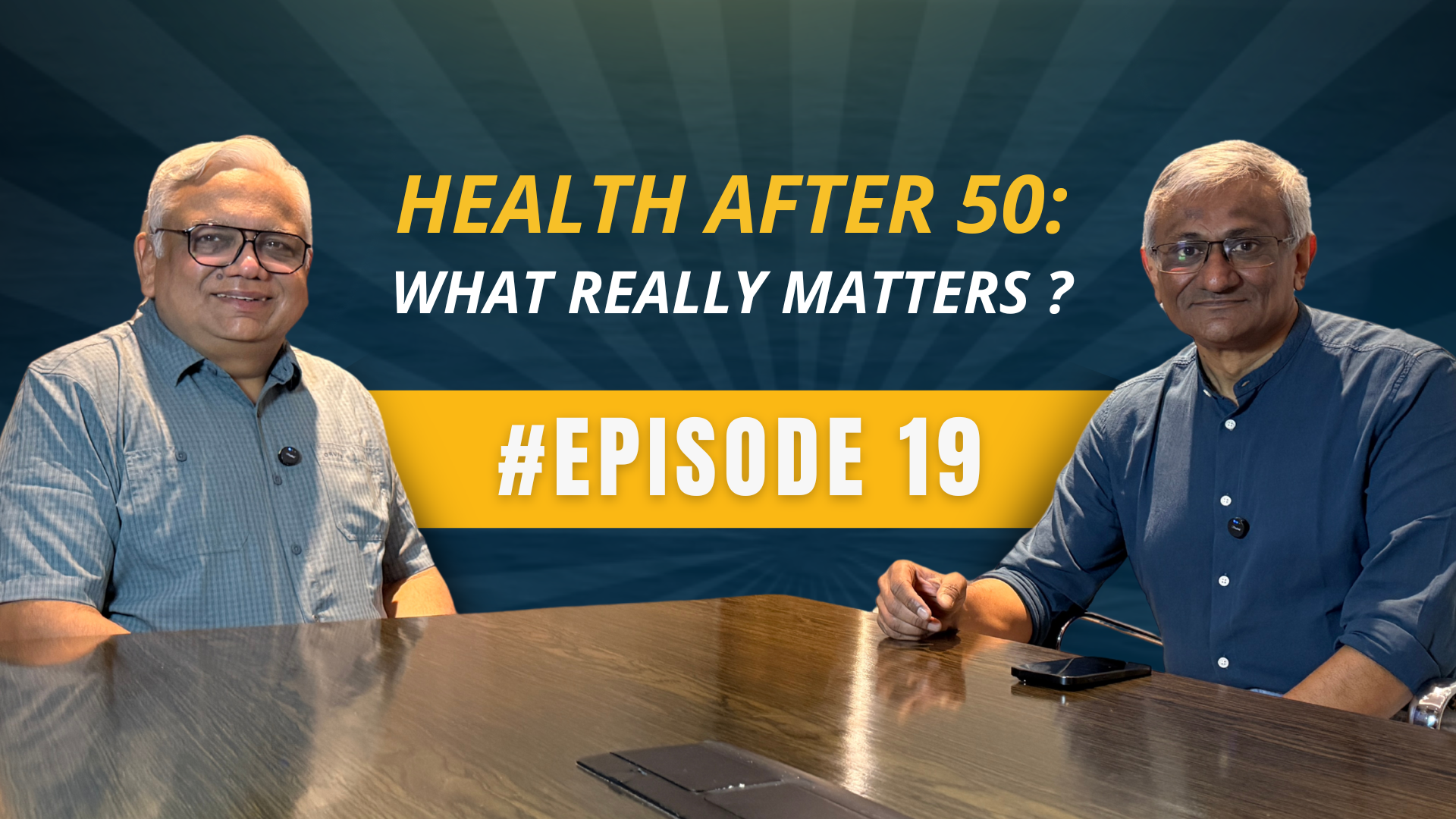
Episode 19 — Ageing Healthfully: A Conversation with Dr. Bhavin Jankharia
In this episode of What If You Live To Be 100, Sanjay Mehta is joined by Dr. Bhavin Jankharia — radiologist, long-time runner, and author of Atma Swastha.
As we move through our 50s and beyond, health becomes less about reacting to problems and more about making thoughtful, informed choices. This conversation explores what it really means to age well — cutting through noise, trends, and misinformation to focus on what genuinely matters.
Below is the full transcript of the conversation.
SANJAY MEHTA: In this continuing journey with the series, we’ve been trying to figure out what it takes for us to lead better lives in the second innings — the time after we are 50, and especially in that zone of 50 to 65 or 70 years or so — the space we call the prime generation or the prime years of life. We’ve been talking about the various facets of life we need to address at this stage, and one of the key ones is health.
I’ve spoken with my limited understanding about health, but the subject clearly demands deep expertise — and today we have just that. On this episode of What If You Live To Be 100, please welcome Dr. Bhavin Jankharia, a very eminent radiologist and extremely well-acclaimed medical practitioner. I’ve known him for many years as a doctor and as a friend. He’s a marathon runner of long standing, a writer on non-medical topics in newspapers, and the author of a popular series called Men from Matunga, which he converted into a book. More recently, he has developed a deep interest in exactly this space — how do we age healthfully, as he calls it?
He has channelled his inquiry and findings into a book called Atma Swastha — and as the name suggests, his clear conviction is that it’s up to each of us as individuals to do the best with our health. He also maintains a website for Atma Swastha, constantly updated with new research and findings. I’m a subscriber and I enjoy reading those articles. So without further ado — welcome, Bhavin. Please share some initial thoughts on how we age better at this stage of life.
DR. BHAVIN JANKHARIA: Thanks, Sanjay. The entire thing came about because I’m ageing — I’m 61 now. When I was around 56, about five years ago, I started Atma Swastha. I was looking at my life to figure out whether I was living as healthily as possible. You mentioned that I used to run — I still run, though I don’t participate in marathons anymore. And for quite some time now I’ve been lifting weights, trying to eat sensibly, and trying to sleep well.
But the question was: from a scientific, data-driven perspective, what actually impacts us, how much does it impact us, and what is truly important versus what is noise? In December, I started the site — I started looking at the data, and every week or two weeks I would write an article. After about two years, this morphed into a 15-point guide to live long and healthy, because by then I’d covered a whole range of topics — everything from how air pollution or heat affects our health, down to actionable points. Every piece I write ends with: so what does this mean for you and me? We need to translate findings into something we can actually do.
SANJAY MEHTA: Which brings us to the lifespan-versus-health-span concept. Can you explain that?
DR. BHAVIN JANKHARIA: Statistically, most of us are pretty much going to live till we’re 90 — that’s almost a given. Obviously not everyone will; some will have accidents, cancers, heart attacks, strokes. But the vast majority will pull through. The question is: will you be independent? You don’t want to be at the mercy of your children, relatives, or society. You don’t want to be in an assisted care facility, dependent on others for your daily needs.
We’ve all had relatives who just lay in bed — they lived to 90 or 95, but for the last 20 years they were effectively a burden. You don’t want that. Which means you need a longer health span — a contracted disease span. If we’re going to live till 90, ideally the major diseases should compress into the last five years, and you lead a very healthy life until about 85. That long health span within a long lifespan is the goal.
So the bigger question isn’t just treating disease when it occurs — it’s how do you prevent disease from occurring in the first place? Most preventive healthcare focuses on finding disease early. When you go for a health check-up, you’re essentially turning a normal human being into a patient by looking for disease. That’s one part. But the bigger part is prevention — stopping disease from occurring at all. That’s what I’ve been writing about.
SANJAY MEHTA: We’re all constantly bombarded on social media with advice. Your 15-point guide cuts through that confusion. But let me ask a more fundamental question. You’d always been running — by the time you were 50, you were among the fitter people. Some of us are not. If someone is at 55 or 60 with varying levels of health conditioning — is there still hope?
DR. BHAVIN JANKHARIA: Everything is changeable with time. You can’t wake up at 60 and expect to look like Milind Soman in three months — that’s not going to happen. But realistically, at any age when you start changing things, it makes a difference. I actually wrote a piece on this — researchers tracked people who only became physically active at the age of 70, and found that as long as they started and didn’t stop, they did better than those who remained inactive. It didn’t matter what age you started. You just need to start — and not stop.
Now, people talk about 10,000 steps, running, ripped bodies — all of that. But what we really need to understand is that humans were not designed to be sedentary. If you go back 100,000 years and look at how we evolved, sedentariness is really a 200 to 300 year problem.
Up to the 1800s, the average lifespan worldwide was about 40 years, and in India about 30 years. We are living long now because of massive improvements in sanitation, nutrition, clothing, shelter, antibiotics, vaccines, and healthcare. You could argue: if we’re already living long, why does the sedentary lifestyle matter? The answer is: you will live long, but you will live a diseased life.
With physical activity, there’s a lot of noise out there — but there is solid, untainted research. Nobody is pushing a product. If you have a drug study, even in leading journals like The New England Journal of Medicine or The Lancet, there’s always a nagging question about pharma sponsorship. With physical activity, there is no one who gains commercially. Researchers in universities track people’s physical activity over 10 to 20 years. Initially through questionnaires — though self-reporting can be unreliable — and now with accelerometers: Apple Watches, Fitbits. Accelerometer-based research started around 2013, so we now have 10 to 15 years of data.
And it’s boiling down to this: the bare minimum is literally five minutes of moderate to vigorous physical activity per day. Brisk walking for five minutes daily — versus doing nothing — changes your risk profile by 50%. Now, five to seven years difference might not sound dramatic. But if you build up to 4,000 steps a day — roughly 3.2 to 3.5 kilometres, or 35 to 40 minutes of walking, six days a week — you’ve pretty much addressed one-third of your health problems. Add cardiorespiratory training, look at your VO2 max, add some strength training — and your risk profiles change significantly.
SANJAY MEHTA: What about food?
DR. BHAVIN JANKHARIA: Food is where all the influencers and everyone can play with your mind, because the science is also not very clean — most of it is sponsored by food companies. So the guidance has to be sensible eating: keep your calorie count at your standard level, eat a little bit of everything, and try to minimise ultra-processed foods. You can’t avoid them entirely, but you don’t want a packet of Doritos or Lays every day.
Sleep is another one. If you read Matthew Walker’s book, he’ll tell you everything boils down to sleep — which isn’t quite right either. You need six to eight hours of sleep. Not less, not more. If you can do that, you’re good. If you can’t, you should get help.
SANJAY MEHTA: And what are the major threats we should be thinking about?
DR. BHAVIN JANKHARIA: The big five things we don’t want: a heart attack, a stroke, a fall resulting in a fracture, a cancer, and premature dementia or cognitive decline. Physical activity addresses all five. Sensible eating and sleep address several of them.
For cardiovascular risk: make sure your blood pressure is under control — you must measure it. Make sure your blood sugar is under control. Make sure your lipid levels are under control. Take care of those three, and your cardiovascular risk is reasonably managed.
For cancer: there are very few cancers where we have enough evidence that early detection changes outcomes significantly. For women, mammography and HPV DNA testing for cervical cancer are the key ones. Beyond that, the evidence thins out considerably.
And then there’s falling. People over 60 who are looking at their phones while walking on uneven pavements — that’s a recipe for disaster. You fall, you fracture. And it’s not just that one event — the health span impact of a fracture can reverberate for the rest of your life. People think of it as an isolated incident, but it’s much more than that.
Environmental factors also matter: during a heatwave, structure your day so you’re indoors in a cool environment, not outside at 2 in the afternoon. When the AQI is 400 or 500, keep windows shut, use air purifiers, limit time outdoors. And don’t neglect vaccines — influenza, pneumococcal, tetanus if you’ve had a scratch.
SANJAY MEHTA: You’ve mentioned both the importance of health check-ups and the risk of over-testing. Can you demystify what’s worth checking and what isn’t?
DR. BHAVIN JANKHARIA: Let me go on a tangent first. There is a blood test that picks up a range of cancers — it’s become popular abroad and some people in India have managed to get it done. If it signals a cancer, you then need a whole-body MRI or PET-CT to find it. It has false positives and false negatives. Just a couple of days ago, the first randomised controlled trial done in the NHS — tracking a large number of people over three years — showed that this test doesn’t help in finding cancers at stage 3 or 4. Which means it’s not useful. And a useless test brings with it a whole lot of problems.
Similarly, some health check-up packages will offer you an MRI of any region you choose. Why would you do an MRI of an area that isn’t causing you problems? You’ll always find something. A study out of Sweden just two weeks ago looked at the opposite, asymptomatic shoulder in people who had a symptomatic shoulder — and found that more than half had some rotator cuff problem that would show up on MRI. So what’s the point? As you age, there is wear and tear of body parts. You can’t unsee an MRI result, and then you worry needlessly.
So: do what is essential. On a yearly basis — a physical examination to look for lumps and bumps, blood pressure, blood sugar, lipid levels. A chest X-ray once every three to four years is a very Indian thing — TB is still endemic here and many of us can be asymptomatic carriers. For women over 60: mammography once a year or every two years, and a bone density scan at least once. HPV DNA for cervical cancer once every five years.
Then there are tests where you really need to understand the implications before deciding. The serum PSA — which picks up prostate cancer — is one of them. If you find a cancer after the age of 70, the question is: is this the cancer that will kill you, or is it one of the 30% that just lingers and will never cause harm? Autopsy studies in patients over 80 have found cancer foci in the prostate in about half of them — but they died of something else entirely. Treatment for prostate cancer is not straightforward — there are issues with erections, infection, urination. The concept of active surveillance exists elsewhere but not really in India. Patients hear “cancer” and want it out.
So was it worth doing the PSA in the first place? It depends on your risk appetite. If you want to find everything and deal with it — go ahead. Someone like me will say: I don’t want that information, and I won’t get my serum PSA done. These are conversations most doctors don’t have time for, so you have to think it through for yourself.
SANJAY MEHTA: You mentioned AI as a useful tool here. How should people use it — and what are the limitations?
DR. BHAVIN JANKHARIA: Instead of Googling — where you get taken to links that are often unreliable or outright fraudulent — if you ask well-prompted questions to ChatGPT, Gemini, or Claude, telling them you’re a 60-year-old Indian in Mumbai with these habits, and ask whether you should get a serum PSA done and what the pros and cons are, you’ll get a more nuanced answer. At least right now, the AI by and large gives answers based on the available data and science.
But — and this is important — you can’t just write a prompt saying “tell me 15 things to stay healthy” with no context and expect magic. It works best for focused questions after you’ve done some reading. Take an article like mine, or a peer-reviewed article, put the PDF into the AI and ask it to explain the findings in plain language. That’s where it shines. As a standalone oracle for health decisions — not quite.
SANJAY MEHTA: For our listeners who don’t have a medical background — how do you identify trustworthy sources?
DR. BHAVIN JANKHARIA: It’s genuinely difficult. I know of an influencer who was a management graduate, started calling herself a doctor, became a health coach with high-profile celebrity clients and a wall of testimonials. When challenged about her lack of domain knowledge, she went and got a degree from Ireland that allowed her to use the doctor tag. She is trusted by a large following. As a layperson, how would you know?
This is the problem of epistemic trespassing. My domain is radiology — within that, there’s no ambiguity about who has expertise. But when it comes to health at large, I’ve used my medical knowledge and writing skills to translate research for people. Every time I write outside my core radiology domain, I give references, because I’m also signalling: I’m not the primary expert, I’m a translator. I try to be diligent — for example, before writing about Vitamin D supplementation, I consulted endocrinology friends who actually caught a couple of my words and made me change them.
A stock market guru who runs a highly regarded firm and then starts giving health advice — you just can’t. You might talk about your personal journey: I had this problem, I did this, here’s what happened. But then to say “this is what you should do” — that’s where the line is crossed. Sachin Tendulkar is a useful model here — every time someone asks him about something outside cricket, he says “I’m not an expert, don’t ask me.” That’s exactly how it should be.
The practical guidance: try to find out who the person is, where they come from, and what their domain knowledge actually is. If they’re experts in another field, apply real scrutiny before taking health advice from them. And the content I produce — I don’t push it into WhatsApp lists. I put it on my website and Instagram, and it’s for you to find. If you subscribe to my mailing list, it’s because you chose to. That kind of self-selection, to me, creates more genuine trust.
SANJAY MEHTA: Let’s talk about biohacking — measuring everything, optimising everything. Is it worth it?
DR. BHAVIN JANKHARIA: No data, nothing solid. These are mostly rich people — technologists and engineers who believe 1 + 1 = 2. In medicine, 1 + 1 doesn’t equal 2, because every body is different. Every individual’s response to drugs, treatments, or supplements is different. And you cannot predict outcomes with precision.
Supplements — every year, every two years, there’s a new fad. None of them work in any meaningful way. People say, “if it doesn’t harm you, why not?” But when you take supplements, you’re putting things into your body whose effects you don’t know. The exceptions: Vitamin B12 and Vitamin D, but only if you’re actually deficient. Beyond that, manganese, magnesium, this mineral, that mineral — it’s mostly pointless.
The irony is that many of these biohackers are also physically active, eating sensibly, sleeping well, getting their vaccines, monitoring their blood pressure and blood sugar. Those are the things that are making the difference. Everything else is noise. The danger is that you focus on the noise — wearing an Oura ring, using a CGM when you’re not diabetic to flatten your glucose curves — and tell yourself you’re being health-conscious, while not going for a walk.
CGMs are valuable for diabetics. For a normal person, the fluctuation in blood glucose after eating is normal physiology. You don’t want to tamper with that simply because an influencer told you to flatten the curve.
SANJAY MEHTA: Let’s end with a topic where there is a lot of polarisation — GLP-1 medications. The Ozempics of the world. Some call them revolutionary, some call them dangerous. Where do you stand?
DR. BHAVIN JANKHARIA: This one has to be more nuanced, because the data is only about five years old. And the polarisation — it’s fine if patients are polarised. What’s unfortunate is when doctors are polarised.
Let me go through the levels. If you have severe diabetes and you’re on insulin — GLP-1s make a difference, that’s what they were created for. They’ll help control your diabetes and blood sugar, and the weight loss is an additional benefit. No argument there, these drugs should be prescribed.
The second level is obesity. I know a friend whose wife is a little obese — she has knee pain, and every doctor she goes to says “I won’t look at your knees until you lose weight.” But she says she barely eats, and she can’t exercise because her knees hurt. It’s a vicious cycle. She went on Mounjaro, and everything changed: the knee pain reduced, she could walk more, she could control her eating better. The drug broke the cycle.
How long does she take it? What are the long-term effects? Here’s my thinking: if we’re taking statins or antihypertensives for life, fine — we’ll take this for life. Maybe ten years from now we’ll know more about side effects, but nothing major seems to be emerging. If it works for you — why not?
Now the softer indications: you want to fit into a dress for a wedding. Everyone’s doing it. Here I’d say — if you’re making an informed, conscious decision and you understand what you’re doing, it’s ultimately your call. This is the same logic as the PSA question. Be well-informed, do your research, and then do what you want with your own body. Just don’t push your choices onto others unless you’re a domain expert.
These drugs were actually created as anti-diabetic medications — the weight loss and other benefits were tangential discoveries. And then the data started emerging: they help with fatty liver, they have anti-inflammatory properties. For knee osteoarthritis, they not only help through weight reduction — they appear to have direct anti-inflammatory effects in the joint. If they work for you and improve your quality of life, they are worth exploring. I just urge people to stay abreast of the research, and to be cognizant that we don’t yet have long-term data beyond five years.
SANJAY MEHTA: And do you practise what you preach?
DR. BHAVIN JANKHARIA: Most of it — 85 to 90%. I’ll give you an example of where I don’t. If the AQI is 200, or if the dew point is 24, you’re not supposed to be running outdoors. But if it’s my run day, I’ll take a conscious call to still run — just for less time. Is that backed by hard data? Not really. My reasoning is that running is still giving me benefits, even if running in an AQI of 200 is a little harmful. I compensate by hydrating more and managing my electrolytes. But my recommendation to others would be: do not run when the AQI is above 200 to 250, and do not run when the wet bulb temperature is above 25 to 26 degrees.
The point is: once you understand the principles behind the guidelines, you can take a more nuanced approach for yourself. These numbers are meant as guidance — the underlying data isn’t always iron-clad.
SANJAY MEHTA: One final thought — you’ve been explicit that everything we’ve discussed is for a specific audience.
DR. BHAVIN JANKHARIA: Yes, and I want to make this very clear. Everything I’m saying is for people above 50 or 55 who have some control over their time, who are reasonably well-off, and who are reasonably well-educated. You cannot translate any of this to a 35-year-old labourer. There is no connection. I know my socio-cultural-economic environment and I write for that environment. I am not qualified to write for someone outside that milieu.
So when you hear this — and I’m assuming the audience of this series comes broadly from that same milieu, with gradations — please keep that context in mind. This is for roughly 15% of India’s population who can realistically act on this.
SANJAY MEHTA: Absolutely. And that’s exactly the audience for What If You Live To Be 100 and Ananta Quest — not because we can’t care about everyone, but because we’ve chosen a space where we can genuinely be useful. The exciting thing about being at this phase of life is that many of us do have choice — choice about when to step out in the sun, whether to take an afternoon nap, how to structure our days. That’s a kind of wealth that’s worth using well.
Dr. Bhavin Jankharia’s 15-point guide, his book Atma Swastha, and his website will be linked in the notes for this episode. The book is designed not just to be read but to be used — you can track your habits and make notes as you go. Do get a copy if this conversation resonated with you. And Bhavin — thank you for the time, and for a genuinely candid conversation.
DR. BHAVIN JANKHARIA: I always like to talk. Thank you for listening.
This conversation is a reminder that ageing well isn’t about doing everything — it’s about doing the right things consistently.
Simple habits, applied over time, matter far more than complex interventions.
If this resonated with you, you can explore more through Atma Swastha and continue following What If You Live To Be 100 by Sanjay Mehta.


